
Image Above: PRF President Michael Ramey with Advisor Angela Burton at the Hidden Foster Care Symposium in 2026.

What if you knew that a bill affecting parental rights was about to come up for a vote, but you only had 48 hours to make your voice heard? In January of 2025, parents in Indiana didn’t even have that long. A Senate vote on a key Parental Rights bill was announced with only one day’s notice, and by the time we learned of it, we could give concerned Hoosier parents only hours to weigh in before the hearing was convened. Forty-eight hours (the standard in many states) may sound like plenty of time. But for parents who are working, caring for their children, and managing everything else that comes with family life, an important alert can be easy to miss. Now imagine that the window closed before you even knew there was an opportunity to speak up. What if a bad bill passed, and you later learned that you could have contacted your representative, submitted a public comment, or encouraged other parents to do the same? When parental rights are at stake, timing matters. Parents cannot exercise their voice if they do not know what is happening until it is too late to do anything about it. That is why the Parental Rights Foundation has recently introduced text alerts. Our text alerts will not replace our regular emails. They will work alongside them, giving us another way to reach you when something important is happening and time is of the essence. In March of 2024, the Tennessee House Children & Family Affairs Subcommittee gave only two days’ notice before a hearing and vote on HB 2936, which stood to take Tennessee from having zero parental rights law to one of the best in the country. Once again, we sent a “Call TODAY” email alert, giving some parents only a few hours in which to make their voices heard. Thankfully, many stepped forward and the measure was passed. But what if time had run out? The goal is simple: We want you, the parent and the voter, to know what is happening when it is happening, so you have the opportunity to get involved and defend parental rights. You should not have to find out after the vote that there was an opportunity to make your voice heard. Legislative alerts are the biggest part of what you'll receive, but we'll also use text messages to let you know about breaking, significant parental rights news as well as other opportunities to make your voice heard. If you have not already signed up, we encourage you to join our text alerts today.

Pennsylvania State Representative Wendy Fink is sounding the alarm: The Shapiro Administration has proposed new Department of Health regulations “reminiscent of the COVID lockdown era that would infringe upon constitutional norms and civil liberties.” Some of the concerns include a provision allowing Department of Health agents to enter homes, schools, or other locations without a warrant; a mandate that every vaccine provider report every vaccination to a statewide vaccine database; and a provision allowing DOH staff to interact with children at school without parental notice or consent. You can see Rep. Fink’s page listing her concerns here . Your parental rights should not end at the public-school door, nor be pushed aside simply because the one doing the pushing serves with the state Department of Health. However great the State’s interest in public health, you as the parent are best situated to make the right healthcare decisions for your child . Concerned parents in Pennsylvania are urged to submit comments on the proposed regulations during the public comment period, which ends September 21. Comment letters must be emailed to irrc@irrc.state.pa.us and RA-DHCHAPTR27PROPRG@pa.gov . To be considered, the email must reference Rulemaking #10-242: Communicable and Noncommunicable Diseases; IRRC #3490. Any questions may be directed to the office of Rep. Fink, whose contact information is on her webpage . Thank you for making your voice heard for all families in Pennsylvania and for protecting children by empowering parents.
We’re back! The EPPiC Broadcast , the official podcast of the Parental Rights Foundation, launched its 13th season on Tuesday, September 8, with Albany Law School Associate Professor of Law Dale Margolin Cecka. (EPPiC stands for our motto, slightly reordered: Empowering Parents, Protecting Children .) This week, Professor Cecka and I spoke at length about the anonymous Child Protective Services (CPS) call that was used to traumatize the family of former U.S. Transportation Secretary Pete Buttigieg earlier this summer. Cecka is an expert on the topic, having first come to the attention of the Parental Rights Foundation with an article she wrote for the Catholic University Law Review in 2015, “Abolish Anonymous Reporting to Child Abuse Hotlines.” As we discuss in the episode, today 47 states allow anonymous reports to their child abuse hotlines , where a single allegation of wrongdoing can lead to intrusion of a family’s home by eager, well-meaning child welfare investigators on a fishing expedition. As Secretary Buttigieg discovered for himself, the investigation alone can be severely traumatizing for both parents and children. Next week, my conversation is with Jim Mason , president of the Home School Legal Defense Association (HSLDA) , and a former president and board chairman of the Parental Rights Foundation. In the episode, Jim speaks about the recent setback that homeschooling suffered in Connecticut , which passed a law restricting homeschool freedom, the first such “step backwards” since the modern homeschool movement began in the 1970’s and ‘80’s. He also speaks of the reasons to remain optimistic, and how homeschooling has now moved “beyond being a movement” to “an enduring American tradition.” Each episode lasts about 30 minutes and highlights one facet of life where your parental rights might be involved. As these two episodes suggest, this season will stay the course set out in the first twelve of finding and balancing experts from both sides of the political spectrum . We’ve found that this helps every listener to find someone they are comfortable with—and to be challenged by someone or something with which they are not. Most importantly, it demonstrates that, regardless of one’s political orientation, we are all in this together. Parental Rights are vital for everyone! Looking ahead, this season will include discussions on reinstating parental rights after their termination (TPR, or Termination of Parental Rights); a poll about educational freedom; a study on Hidden Foster Care across all fifty states; a new book on child welfare reform (not even out yet!); and more. We’ll look at bipartisan legislative issues from Pennsylvania to Texas to Illinois, and follow parental rights in U.S. federal courts. The season runs roughly three months, through the end of November. So, I invite you to take a listen today, and pass it on to your podcast listening friends, too. The EPPiC Broadcast may be just the parental rights coverage you and they have been looking for! Thank you for standing with us to protect children by empowering parents!

Sometimes success looks like somebody else’s news article. Such was the case last week when Lauren Peace and Teghan Simonton of the Tampa Bay Times released their investigative report, “Hillsborough’s Foster Agency Celebrates Keeping Families Intact. It Separated Hundreds Off the Books.” If you’ve been following us for any length of time, you know a lot of the work of the Parental Rights Foundation happens in coalitions, and a lot of it happens behind the scenes. Part of that work was drafting a model bill with the Coalition to End Hidden Foster Care to preserve families’ rights when they’re facing the kind of separation Peace and Simonton wrote about. See, while Hillsborough, Florida, celebrates having fewer children in foster care, it turns out they’ve only lowered those numbers by sending children to live with relatives instead. The parents had no more say in it than if the children were taken to foster care, although it happens under a guise of “consent.” Parents sign the paper, but only because they’re threatened with losing their children to foster care if they don’t. And who wouldn’t choose to send their children to live with grandma or an uncle if the only other option is a stranger? But this form of “Hidden Foster Care” robs families of crucial legal safeguards. They don’t ever get their day in court. The caregivers don’t get supports that regular foster families do. And often there is no exit strategy, no path by which the kids eventually come home. All of these problems are highlighted in the Times article. They’re problems our model bill seeks to address. And they’re problems we’ve been highlighting for years, both in this email newsletter and on our EPPiC Broadcast podcast, which launches its thirteenth season on Tuesday (September 8). In fact, three of the experts quoted in the Times article have been guests on our podcast already: Listen to Andrew Brown’s episode on Child Welfare Reform bills in Texas Listen to Josh Gupta-Kagan’s Child Welfare analogy from Star Wars Listen to Shanta Trivedi’s talk on the hidden harms of family separation That these experts have been on our podcast and are also featured in the Times article is no accident. No, I don’t mean that the Times writers came to our podcast site looking for experts to quote. (I suppose they could have, but I have no evidence that they did.) But these experts, like your Parental Rights Foundation, have been working tirelessly for years to call attention to the problems of Hidden Foster Care. Just like us (and in concert with us, as it were), they have been working to change the narrative. Now, this article in The Tampa Times is the latest proof that our efforts are working. See, so much of our work in the field of child welfare reform is about shaping the narrative. When I started here, “everyone knew” that if CPS came knocking on your door, you must have done something wrong. There was shame in just being investigated. But over the last decade and a half, more and more people are waking up to the reality: five of every six CPS investigations nationwide are ultimately closed as unfounded or unsubstantiated. Five times out of six, the family that was investigated had done nothing wrong. That’s what changing the narrative looks like: it’s taking us from “everybody knows you must’ve done something wrong” to “everybody knows innocent families get investigated, too.” Only, with hidden foster care, it’s a little different. With hidden foster care, it takes a change of narrative for there to be any narrative at all. The practice is, after all, hidden. It’s off the books. And it’s off the public radar. It is a major win that a paper the size of The Tampa Times is talking about it at all. And that’s just the kind of change we’re looking for every time we invite Andrew, or Josh, or Shanta back on our podcast. Every time we talk about the problems of hidden foster care, it’s with the hope that an investigative reporter might hear something worth looking into and find it happening in their own backyard. I can’t claim that’s what happened in this case. But I can promise you we will continue to do our part, both to call attention to the problem on our podcast, and to offer solutions through the American Legislative Exchange Council (ALEC) and in your state legislature. Thank you for standing with us to protect children by empowering parents, and by bringing hidden foster care into the light of day.

Every year in the United States, more than 50,000 children lose their rights and access to their own parents through a process myopically called “termination of parental rights,” or TPR. A proposed bill in Pennsylvania, House Bill 133 , looks to address this problem in a modest way: by providing a process by which TPR can be reversed in certain situations. Not all circumstances lend themselves to this kind of reversal. First, after the passage of time, the parent must show that the underlying problems that led to the TPR order have been addressed. Parents who lost their children due to addiction, for instance, might need to show that they have successfully completed treatment and remained sober for some period of time. Second, the child must still be in need of a permanent home. Children who have been successfully adopted will not suddenly be uprooted from their new home and sent back to their parents. But children still languishing in the foster care system can be sent home with the court’s approval. Right now in Pennsylvania, a child can bounce from placement to placement and ultimately age out alone, even when there is a fit and loving parent just waiting to bring them home. The courts there have no path, no legal authorization, to return that child to a parent after TPR. Pennsylvania is not the first state to tackle reinstatement of parental rights. California passed the first such law in 2005 and ten states had passed similar statutes by 2010. Today, twenty-six states have some kind of parental reinstatement law on the books: Alaska, Arizona, Arkansas, California, Colorado, Connecticut, Delaware, Florida, Georgia, Hawaii, Illinois, Iowa, Louisiana, Maine, Michigan, Minnesota, Nevada, New York, North Carolina, Oklahoma, Utah, Vermont, Virginia, Washington, West Virginia, and Wisconsin. Pennsylvania HB 133 was introduced by Rep. Rick Krajewski (D-Philadelphia) in September of last year. The bill has fifteen cosponsors, including one Republican, Rep. Sheryl Delozier of Cumberland County. In legislative parlance, that 14-to-1 ratio makes this a “partisan bill,” Delozier’s support notwithstanding. But it shouldn’t be. Parental rights are a vital interest to all Americans, regardless of party, and restoring those rights whenever possible should be important to those on both sides of the aisle. Fortunately, support for the bill was bipartisan when it counted: the bill passed the 202-member Pennsylvania House of Representatives in June by a vote of 191 to 11. Every Democrat and 89 of 100 Republicans voted in favor. Now the bill is in the Senate, where it was referred to the Judiciary Committee on June 25. Frankly, I’d love to see TPR abolished entirely. Terminating parental rights should at least be used as a last resort, when the compelling governmental interest in a child’s safety cannot be met by any other, less restrictive means. (If parental rights are fundamental rights— and they are —then shouldn’t the termination of those rights require the ‘strict scrutiny’ standard accorded to other fundamental rights?) This is a conversation change that will take some time to bring about. Legal scholars Michael Farris and Vivek Sankaran contributed to it with their own discussion in season nine of our EPPiC Broadcast podcast. Now Krajewski’s bill provides another opportunity to move that conversation forward. If you live in Pennsylvania and your state senator is on the Senate Judiciary Committee , please take a moment to reach out and encourage them to take up HB 133 in committee and vote in favor. Urge them to recognize that the rights it would restore are important to all families , Republican and Democrat alike. If you don’t live in Pennsylvania, look for your state on the list above. If it’s not there, perhaps the effort could be taken up in your legislature in the coming session. Why not ask your state lawmaker to look at HB 133 and consider bringing the same law here? Working together, we can shift the conversation, and we can start to bring the children home—in every state. Thank you for standing with us to protect children by empowering parents through reinstatement laws like the one being discussed in Pennsylvania this year.

August is one of my favorite months because I get to see supporters like you start to create the legislative landscape of the coming year. It was in August of 2017 that volunteer Patti Sullivan first reached out to her state lawmaker, then-Rep. Erin Grall, to propose a parental rights bill in Florida. Rep. Grall told her she could give her 20 minutes; that turned into a two-and-a-half hour conversation. Now-Senator Grall, an attorney by trade, turned our humble fundamental parental rights model into a full-scale Parents’ Bill of Rights. And in 2021, it passed the legislature and was signed it into law. In 2018, we launched our “Resolutionary” campaign, and volunteer Esther in Indiana responded by reaching out to her lawmakers about a parental rights resolution. Her efforts brought in other nonprofit organizations in the state as the resolution morphed into a parental rights bill that passed in 2025. As amazing as these results were, the fact is that both ladies started out just like you. They read our newsletter because they cared about their families and about parental rights for all of us. But they didn’t stop at reading. They took the next step: they reached out to their lawmakers with language we provided and started a conversation about what is best for families. This year can be your turn! Perhaps, like Patti and Esther, you could take our model policies to your state lawmakers and ask them to champion a bill this coming session. For some lawmakers, election year means an arduous campaign will define the next three months. If we wait for that dust to settle before sharing a model with them, though, the legislative session will be right on top of us. And many lawmakers don’t have that concern because they are strong front-runners, or even running unopposed. So, the time to reach your lawmakers with a parental rights model is right now, this month, before campaigns get too crazy. A Model to Fit Every State Red states might be interested in our Fundamental Parental Rights model , which establishes in the legal code that parental rights are fundamental rights and that the state’s courts must apply strict judicial scrutiny —the highest level of review—to cases involving parental rights. Blue states might want to take up our Child Protection Investigations Reform Act , which requires child welfare investigators to notify parents of their rights from the very start of a child abuse or neglect investigation. And nearly any state in the country could take up our Confidential Reporting model , which has already been adopted, notably, in “very Red” Texas and “very Blue” New York. (California also has a version of this protection; the other 47 states are all fair game to take up the measure in 2027!) This model would require a state’s child abuse hotline to collect personally identifiable information like name and address from anyone calling in an allegation of child abuse or neglect. This will greatly reduce the “weaponization” of the System that is rampant across the country. Other available models address Family Rights in Medical Investigations , providing Central Registry Due Process , Reasonable Childhood Independence , and Due Process for Families Facing Potential Separation (i.e. Hidden Foster Care). Every model was drafted with input from friends on both sides of the political aisle and boasts the support of both right-leaning and left-leaning organizations. And each one has been adopted as a model policy by the American Legislative Exchange Council (ALEC), a conservative group of organizations and Republican state lawmakers who look to shape policy across the country. What to Do, Step-by-Step First, identify your state lawmakers and secure their contact information. In most states, you’ll have one state senator and one representative, delegate, or assemblyman. (In Nebraska, you just have one senator.) Next, see what you can learn about them in a Google search. Maybe one of these models touches on a topic that their voting record shows is already deeply important to them! Set up a time to visit with them. Take one of our models with you as a starting point. (You can take more in case a subject comes up, but start with just one so you don’t overwhelm them!) Ask them their position on parental rights and if they would consider championing our model in the coming session. If they say “no,” that is not the end! Ask them instead if they know another lawmaker passionate about this issue. (We have gotten many great champion connections this way!) Alternatively, ask them if they would be open to a different model, or to revisit this model at a later time. Finally, when you get home, send them an email or a postcard thanking them for their time and attention. Ultimately you want to build a relationship with them, as this will pay off huge dividends down the road. Listen: everyone who enjoys those key relationships with their lawmakers today started off just reaching out for the first time. Who knows? Yours could be the next great parental rights success story. Why not let it begin this August? Thank you for standing with us to protect children by empowering parents through positive legislation in your state , coming in 2027!
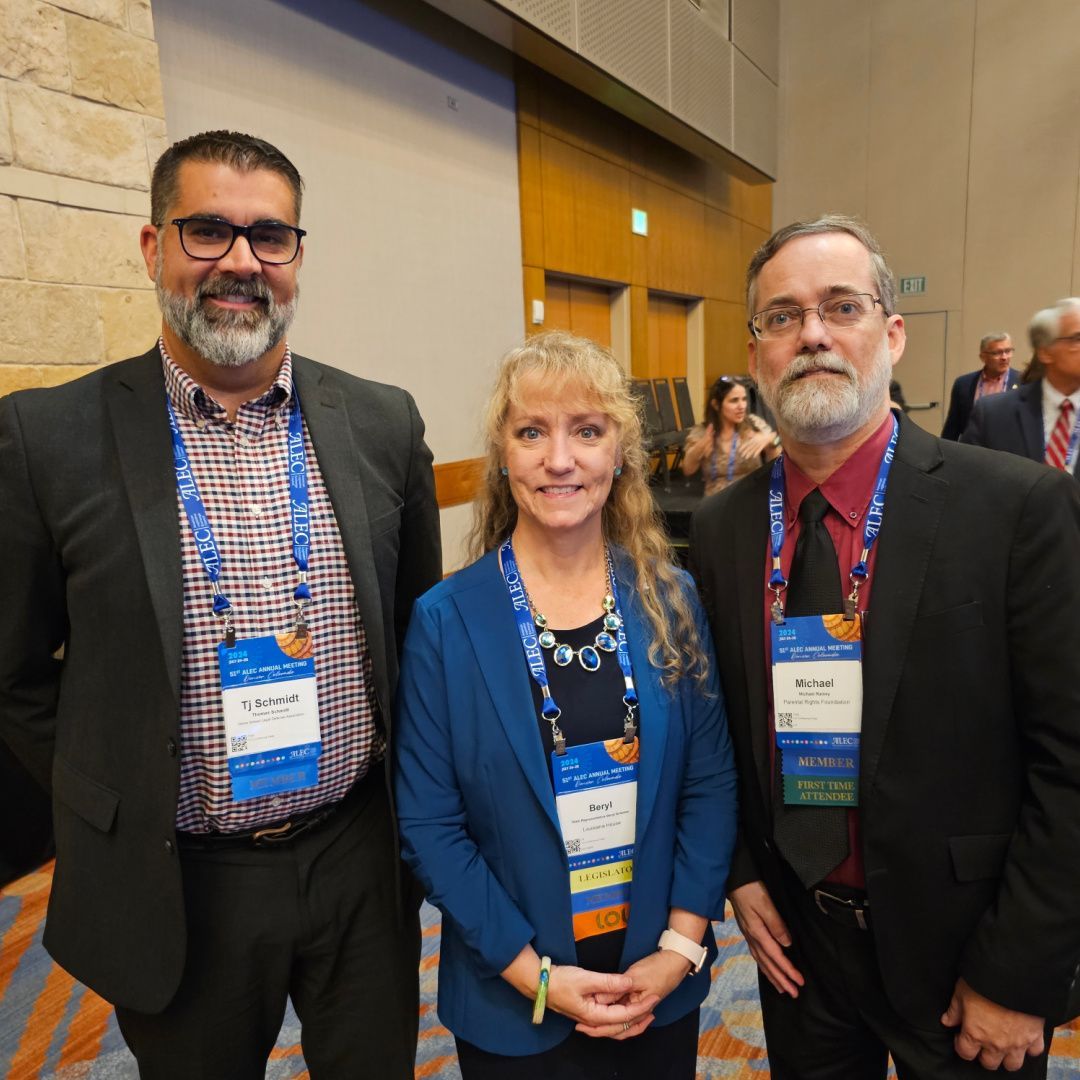
PRF President Michael Ramey with HSLDA attorney Tj Schmidt and Louisiana State Representative Beryl Amedee at ALEC 's 2024 meeting in Denver.

A few weeks ago, we announced a new way to stay informed about parental rights through text messages. If you haven't signed up yet, there's still time, and we'd love to have you join us. The landscape of parental rights can change quickly. Court decisions are released, legislation is introduced, and new research becomes available throughout the year. While we will continue sending our regular email updates, text messages allow us to reach you as soon as important developments happen. When you subscribe, you'll receive: Timely alerts about significant parental rights news Notifications when new Foundation research and resources are released Opportunities to take action when your voice can make a difference Important updates delivered directly to your phone Our goal is not to send more messages. It is to make sure you receive the most important updates as quickly as possible. We'll keep our texts focused, relevant, and respectful of your time. As we look ahead to the next legislative season, now is the perfect time to sign up so you'll be ready to receive alerts when they matter most. If you prefer to receive updates only by email, that's perfectly fine. We'll continue sending our regular newsletters just as we always have. But if you'd like the fastest way to stay informed, we encourage you to subscribe today.

As we celebrate the 250th anniversary of the Declaration of Independence, we still “hold these truths to be self-evident, that all men are created equal and are endowed by their Creator with certain unalienable rights, that among these are life, liberty, and the pursuit of happiness.” We also believe these rights include the liberty of parents to direct the upbringing, education, and care of their minor children without undue government interference. As we celebrate the first 250 years, we dedicate ourselves to the preservation of this fundamental right, to secure the vital role of the family in our republic for the next 250 and beyond. Happy Anniversary, America, and Happy Independence Day.