“Hidden Foster Care” Symposium Strengthens Ties
September 23, 2026
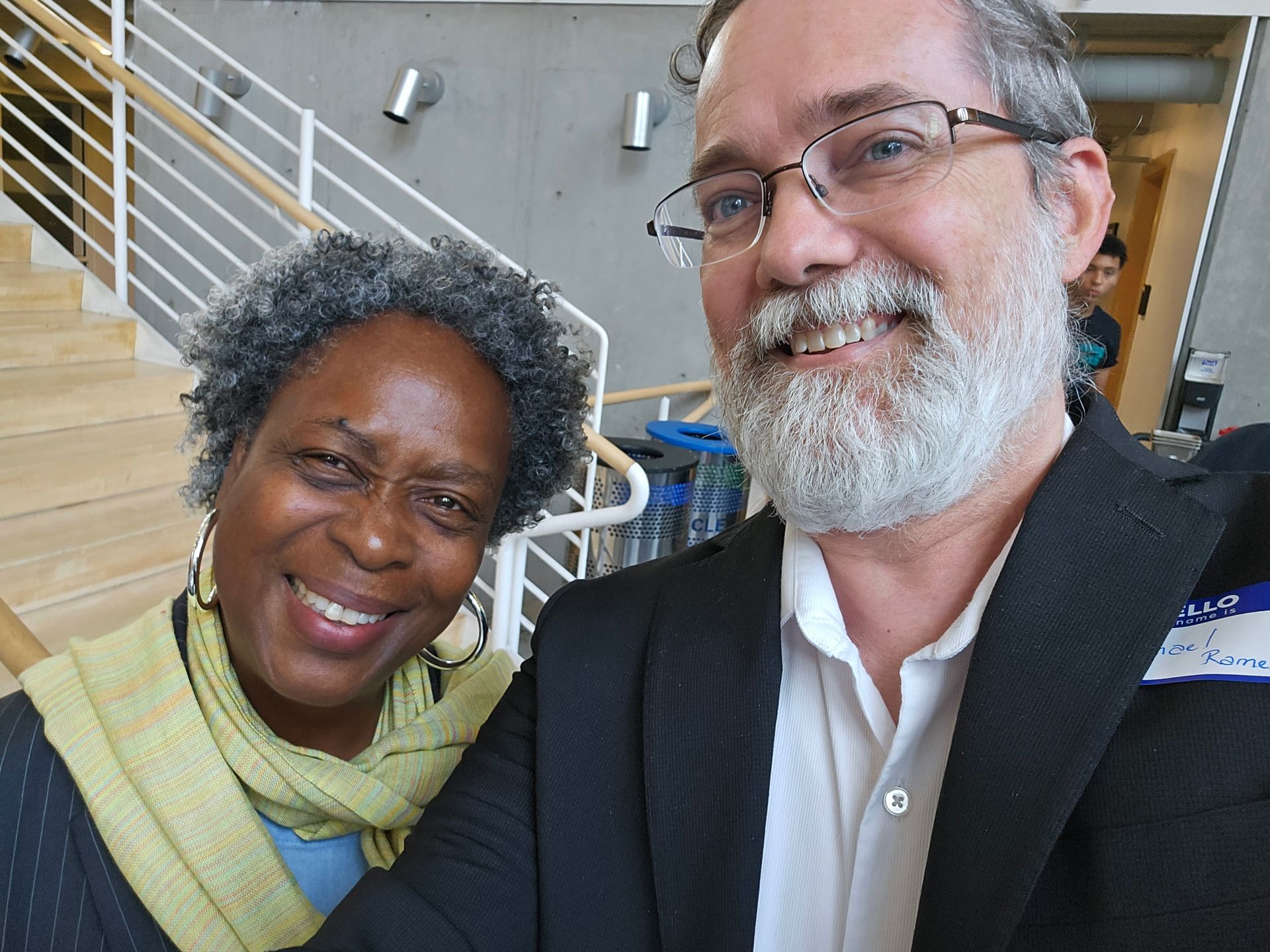
Image Above: PRF President Michael Ramey with Advisor Angela Burton at the Hidden Foster Care Symposium in 2026.
The University of Baltimore School of Law’s Center for Families, Children, and the Courts (CFCC) held a symposium on Hidden Foster Care on September 17, and your Parental Rights Foundation president was in attendance.
Such an event creates an exciting opportunity to meet leaders in the field and grow our network of reliable allies in the fight to preserve families.
But in the post-COVID age of Zoom calls and email conversations, the symposium also presented an opportunity to meet for the first time leaders I have been working with for years and to recharge relationships with those I’ve met only once or twice before.
In the latter camp are Josh Gupta-Kagan of Columbia University, and University of Baltimore’s Aubrey Edwards-Luce. Josh and Aubrey got the symposium started with a Keynote Conversation that combined Josh’s scholarship with Aubrey’s personal experience as a kinship caregiver in a Hidden Foster Care arrangement.
For those new to the term which Josh coined in his 2019 law review article on the subject, Hidden Foster Care refers to safety plans or other diversions that lead to families being separated, ostensibly voluntarily, but without due process of law or any court oversight. Threatened with the specter of losing their children to strangers through official foster care, parents are pressured to send them to relatives or friends instead.
It is in this way that Aubrey came to be guardian for her goddaughter and the girl’s sibling several years ago. Now she is in the awkward and unenviable position of having to referee when and how her friend can spend time with her own daughter. She wants to grant all the leeway she can, but how much is too much in the eyes of the case worker who could still decide to take the girls away?
This is one of the difficulties families face, as unpacked by the day’s two additional panel discussions. The first featured Lisa Chambers of A Second Chance, Inc.; Chelsi Rhodes of Generations United; and Angela Burton, a community lawyer and nationally recognized advocate. (Angela is a member of our Board of Advisors Committee on Child Welfare, and it was a joy to reconnect with her in person!)
Lisa pointed out that such diversions often come with all of the responsibility and none of the authority to raise and nurture a child. As her panel pointed out, the arrangements often create a “new level of poor,” as grandparents are forced, on their own dime and without the funding foster families get, to raise a second generation, this time on a fixed income.
And, of course, there is also the problem of there being no fixed pathway for reunification. Once the families are separated and “the children are safe,” the agency exits the scenario to leave families in limbo.
As Angela points out, “any time the state takes upon itself to tell parents what to do, the constitutional threshold is reached.” At that point, parents are entitled to due process and constitutional protections. But they don’t get any.
The final panel of the day featured Jed Dews of HALOS, Allison Green of the National Association for Counsel for Children, and Natasha Khalfani of the Maryland Office of the Public Defender. Jed and Allison are two national leaders I work with routinely in the Coalition to End Hidden Foster Care, but whom I had never met before in person. Getting to actually be in the room with them was a special blessing.
Their panel shared some troubling data: more than a third of American children will experience agency involvement before the age of 18, including 53% of Black children. This is an epidemic that demands policy solutions and alternatives that provide for family preservation, due process, and oversight.
Notably, there was in the audience a member of Maryland’s Citizens Review Board for Children—a board of community stakeholders created by the governor to provide oversight of the state’s child welfare agency. The aim of the board is to make sure children are being taken care of in the Maryland system. Yet, as she pointed out during Q&A, they only provide review of the cases in actual foster care. She, as a member of the oversight board, never even knew these “hidden foster care” cases existed.
During the course of the day, I was also able to reconnect with University of Baltimore’s Shanta Trivedi, a repeat guest on our EPPiC Broadcast podcast, and to meet in person for the first time Joanna Lack, the executive director of the United Family Advocates coalition of which we have been a part since its inception.
The symposium was a rousing success for our hosts, and a wonderful opportunity for me to strengthen our network and renew my passion for correcting the injustices of these off-the-books family separations.
Thank you for your support of the Parental Rights Foundation in this important work. It is only through your partnership that I was able to attend this event, make these connections, and represent your voice to protect children by empowering parents even when family separations may be necessary.
Share This
Help Protect Parental Rights
Your support enables us to educate and inform the public and policymakers regarding parental rights. We rely completely on donations to operate.
Help Protect Parental Rights
Your support enables us to educate and inform the public and policymakers regarding parental rights.
Be an Informed Parent
Join our email list for updates about parental rights in America.
We will get back to you as soon as possible.
Please try again later.